Article
In this small set of incidents we’ve reviewed here at Realz, image manipulation is not appearing in just one form or one context. The cases span New Zealand, the US, the UK, Greece, and Thailand over just a few days, and they involve very different kinds of harm: sexual exploitation, humiliation, misinformation, reputational damage, and public confusion.
That variety matters. It is tempting to talk about “deepfakes” as if they are one single category of risk. But the incidents reviewed here suggest something more complicated. The same broad family of tools and techniques can be used to target a teenage girl at school, flood the internet with explicit fake imagery of women, create a misleading nostalgic image that fools a well-known social account, or circulate synthetic political imagery at a sensitive geopolitical moment.
The available reporting in this sample is still limited, and several cases are reported but not independently verified in the material supplied here. Even so, the pattern is worth examining carefully: fake images are becoming less of a novelty problem and more of a trust and verification problem.
The incidents reviewed here
A New Zealand prosecution centered on deepfake sexual abuse
One of the clearest cases in this sample is from New Zealand, where Summer Murphy described being targeted by an offender who allegedly used photos from her social media accounts to create sexually explicit deepfake images. According to the reporting, dozens of manipulated images were uploaded to a pornography site with her real name and degrading descriptions, and the material was also sent to friends and family. The offender pleaded guilty and was sentenced to intensive supervision, with the judge reportedly treating the conduct as sexual offending.
Based on the reporting provided, this was not simply a false image incident in the abstract. It was a case of non-consensual synthetic imagery attached to a real identity and distributed in a way that amplified humiliation and fear.
A US celebrity case highlighting scale and persistence
A different US case reviewed here involves Paris Hilton, who said that more than 100,000 explicit fake images of her have been created without consent. In the supplied reporting, she links that experience to advocacy for legal remedies that would allow victims to take action against creators of non-consensual AI-generated imagery.
This case is different from the New Zealand prosecution in visibility and scale, but not in the core harm. In both, a person’s likeness is turned into sexualized material without consent. The larger public profile may change the volume and public discussion, but it does not change the underlying issue: synthetic imagery can be used to strip control from the person depicted.
A Greek school case involving minors
The Greek case is especially troubling because it reportedly involved school-age children. According to the supplied material, police opened a case after a 15-year-old girl alleged that a classmate used one of her photos to create an AI-generated nude image and that it was then shared among minors.
This is a narrow sample, so we should be cautious about broad claims. But this incident does support a specific concern: accessible image-generation and editing tools can move visual abuse into ordinary peer environments, not only celebrity culture or criminal forums.
US prosecutions aimed at large-scale deepfake pornography networks
Another US case in the sample involves federal charges against two men accused of creating and posting deepfake pornography under a new law. According to the reporting, prosecutors alleged the existence of hundreds of albums, 140 victims, and very large viewing numbers for at least some of the content.
If those allegations hold, the significance is not just that synthetic abuse occurred, but that it may have operated at industrial scale. That shifts the issue from isolated harassment toward repeatable, systematized exploitation.
A royal image that fooled a trusted social account
Not every incident in this sample involved sexual abuse or mass dissemination. In the UK case, former royal butler Grant Harrold shared an image he believed showed Prince William and Catherine in 2004. Followers then challenged it as AI-generated, and he apologized and said he had been deceived.
This is a smaller incident in terms of direct harm, but it is useful analytically. It shows that the problem is not limited to malicious operators targeting victims. Synthetic or misleading visuals can also pass through ordinary sharing behavior, especially when they fit an emotionally satisfying story or seem to confirm a familiar memory.
A Thai police image that blended a real event with a synthetic visual
In Thailand, a police officer reportedly used AI to create a humorous image of officers in drag while the underlying arrest details were described as genuine. The image then spread well beyond its original context after being reposted by media.
This case sits in a more ambiguous category than the others. It was not presented in the supplied reporting as sexual exploitation or direct fraud. But it still matters because it shows how synthetic visuals can detach from their original framing once they enter wider circulation. Even when some underlying facts are real, the image layer can still change public interpretation.
Political AI imagery posted in a live geopolitical context
Two US reports in this sample describe President Donald Trump posting an AI-generated image depicting a US strike on Iranian vessels, accompanied by the caption “Adios,” during a period of reported diplomatic discussion. One report also notes that Benjamin Netanyahu used AI-generated imagery in related messaging.
The supplied material does not let us draw sweeping conclusions about intent. But the timing described in the reports is enough to show why political synthetic imagery deserves careful scrutiny. In high-tension contexts, a synthetic image does not need to fool everyone as documentary evidence to shape perception, trigger speculation, or muddy the line between signaling, rhetoric, and reality.
What this small sample suggests
Taken together, the incidents reviewed here point to at least three distinct but related patterns.
1. The same visual techniques can produce very different harms
The most obvious pattern is diversity of impact. In this sample, synthetic and manipulated images were associated with:
- non-consensual sexual imagery
- reputational harm
- humiliation and harassment
- misinformation and public confusion
- political ambiguity
- false memory or false familiarity on social media
That matters because “deepfake” is often treated as a single threat category. In practice, the incidents here show different operational realities. A fake royal photo, a synthetic war image, and an AI-generated nude of a minor are not the same kind of event, even if they share overlapping technical ingredients.
2. Distribution is part of the harm
Across several of these incidents, the image itself was only part of the story. The reported harms escalated through circulation: uploaded to porn sites, sent to family and friends, shared among minors, reposted by media outlets, or amplified through major social platforms.
That is an important editorial lesson. The key question is often not only whether an image is fake, but how fast it moved, who encountered it, and what social or institutional response followed.
3. Trust is being tested in everyday settings, not only crisis scenarios
This sample includes celebrity abuse and political imagery, but it also includes a school complaint, an Instagram post, and a local police Facebook page. That mix suggests the verification burden is spreading into ordinary environments where people are not behaving like investigators. They are behaving like classmates, followers, fans, administrators, or casual viewers.
In that kind of environment, visual plausibility can be enough. A picture does not always need to survive rigorous forensic analysis. It only needs to feel believable for a moment, in the right context, to cause harm.
Why this pattern matters beyond the image itself
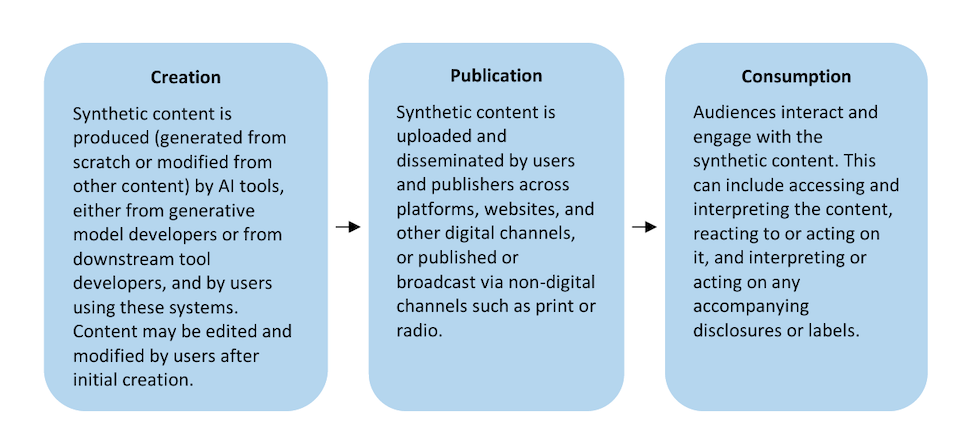
The background guidance supplied for this draft is useful here. NIST treats synthetic-content risk as a transparency and trust problem across creation, publication, and consumption, rather than as a simple matter of spotting fakes after the fact. That aligns with what we see in this incident set.
The NIST figure below is useful because it makes that broader point visible. It shows synthetic content as part of a pipeline rather than a single moment of creation. That matters for this sample, where harm often emerged through reposting, recirculation, reframing, and audience uptake, not only from the initial act of generating or editing an image.
 Source: NIST AI 100-4, Fig. 1, 2024. Adapted with attribution.
Several of these cases were not primarily about technical sophistication. They were about what the image enabled:
- harassment and sexualized abuse
- humiliation tied to real identity
- reputational spillover
- misleading public interpretation
- confusion in politically sensitive communication
That framing is also consistent with institutional guidance from CISA, NSA, and the FBI, which has emphasized that synthetic media becomes operationally important when it supports deception, impersonation, fraud, or access to trust. In this sample, not every case is a cybersecurity incident in a narrow sense. But many are clearly cyber-relevant because they degrade confidence in digital evidence and digital communication.
This is also where the research backdrop helps. Work on social engineering and online deception supports a sober point: deception often succeeds through context, authority, familiarity, and timing rather than through perfect technical realism. The royal image case illustrates that neatly. The image appears to have worked, at least briefly, because it fit an expected story. The political image cases matter for a similar reason. Even when viewers suspect an image is artificial, the image can still frame discussion and push interpretation in a chosen direction.
A narrower conclusion on detection, provenance, and response
The academic and institutional support provided for this draft is strong enough to support one practical conclusion, but not every sweeping claim people sometimes make in this area.
The supported conclusion is this: visual trust cannot rest on human intuition alone.
The supplied reference material points repeatedly to the limits of unaided judgment. It also cautions against treating detection tools as definitive. That is important in light of the incidents here. In the royal case, followers challenged the image after it had already been shared. In the Thai police case, the synthetic image spread beyond its original frame. In the sexual abuse cases, the core challenge was not merely recognizing manipulation, but dealing with distribution, attribution, takedown, legal remedy, and victim harm.
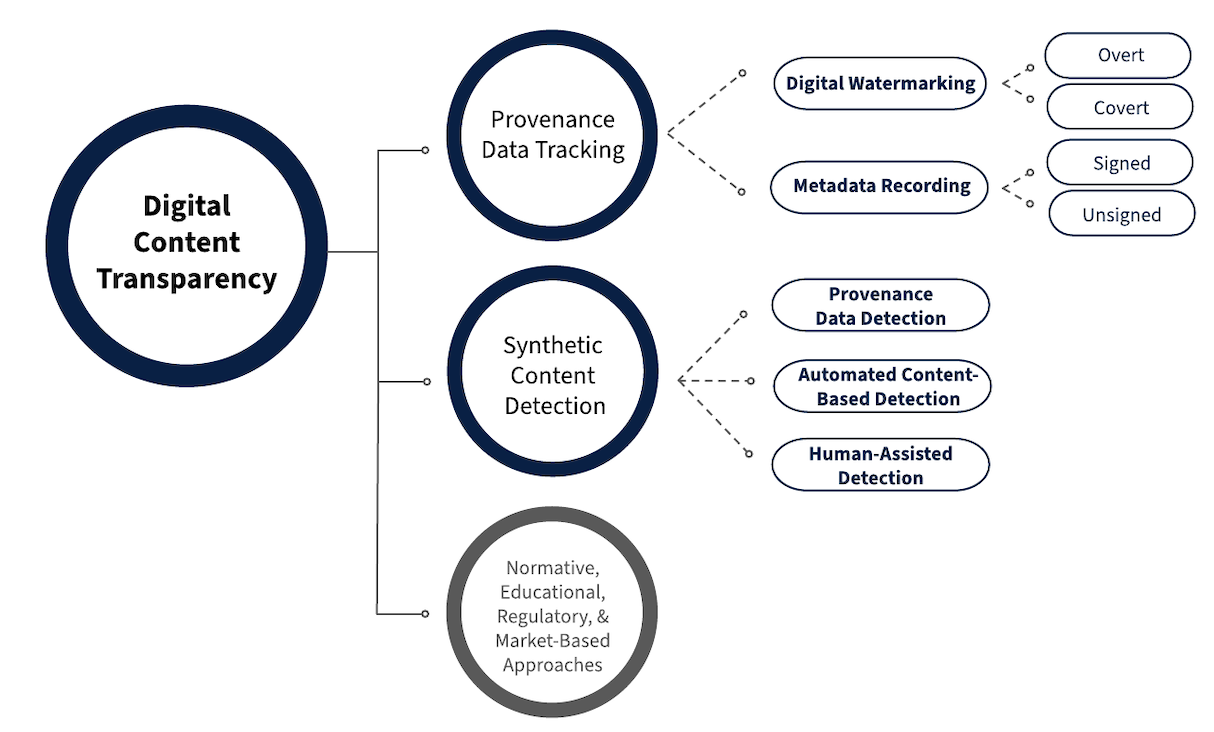
The second NIST figure is especially helpful here because it maps multiple transparency methods side by side. That matters for this article’s narrower conclusion: detection is only one part of the picture. Provenance, authentication, labeling, and related controls may all contribute, but none of them removes the need for contextual verification and response.
 Source: NIST AI 100-4, Fig. 2, 2024. Adapted with attribution.
So a realistic response has to be broader than “spot the fake.” For institutions, publishers, schools, platforms, and public figures, the stronger questions are:
- What verification steps exist before resharing or endorsing a striking image?
- What evidence should be preserved when a harmful synthetic image appears?
- Who owns takedown, legal review, communications, and victim support?
- When should an image be treated as unverified, even if it is emotionally compelling or socially useful?
- Where can provenance signals or content credentials help, and where are they absent?
NIST’s transparency guidance is relevant here because it frames provenance, authentication, watermarking, detection, and auditing as complementary rather than interchangeable. That fits this sample well. No single control would have addressed every case reviewed here.
What leaders and institutions should take from this sample
Because the supplied support is solid on governance and verification, a modest leadership takeaway is justified.
In the incidents we’ve looked at here at Realz, the recurring weakness is not simply that fake images exist. It is that many digital environments still lack clear, routine ways to verify, challenge, label, escalate, and respond to suspect visuals.
That has different implications in different settings:
- Schools may need clearer reporting and safeguarding pathways for non-consensual synthetic imagery involving minors.
- Public figures and media-facing teams may need stricter verification before resharing emotionally resonant images.
- Platforms and publishers may need better escalation paths for manipulated content that targets identity, reputation, or public understanding.
- Organizations more broadly should treat visual authenticity as part of communications governance, incident response, and decision quality, not as a niche media-literacy issue.
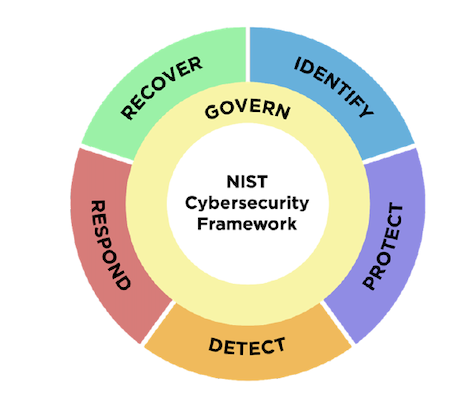
The NIST CSF 2.0 figure below helps keep that point grounded. It is relevant not because these incidents are all classic cybersecurity cases, but because the framework reminds us that governance, identification, protection, detection, response, and recovery are connected functions. In this sample, visual-authenticity problems cut across several of them at once.
 Source: NIST, The NIST Cybersecurity Framework (CSF) 2.0, Fig. 2, 2024. Adapted with attribution.
That does not mean every manipulated image should trigger a full cyber incident process. But this sample does suggest that visual-authenticity issues are increasingly intersecting with governance, legal exposure, public trust, and human harm.
The deeper trust problem
The broadest lesson from this sample is also the simplest one.
Fake images do not all fail in the same way, and they do not all harm people in the same way. Some are built to humiliate. Some are built to persuade. Some are built to amuse. Some are shared carelessly rather than maliciously. But once synthetic visuals become easy to make and easy to circulate, the burden of proof shifts onto everyone else.
That burden is now visible across this small set of incidents we’ve reviewed here: victims trying to prove abuse, audiences trying to judge authenticity, public figures trying to explain themselves after sharing false imagery, and institutions trying to decide what is real quickly enough to respond.
That is why the issue is bigger than any single fake image. It is about the conditions under which people decide what to believe, what to share, and what to act on.
And in that sense, the real challenge is not only synthetic media. It is synthetic confidence.