Article
In this sample of incidents we’ve reviewed here at Realz, the cases are narrow in geography and time: eight reported incidents, all tied to the United States, across just a few days in May 2026. That makes this a limited editorial snapshot, not a comprehensive survey of image-related abuse.
Even so, the incidents are useful because they show something important about visual authenticity in public life. The core problem is not simply that AI-generated images are becoming more common. It is that synthetic visuals can now be inserted directly into political messaging, public commentary, and online confrontation with very little friction.
In the incidents reviewed here, the images were reported as AI-generated, but several were only reported and not independently verified. That uncertainty matters. Still, taken at face value as reported, the cases point to a recurring pattern: synthetic images being used to degrade opponents, dramatize political claims, or intensify already-polarized narratives.
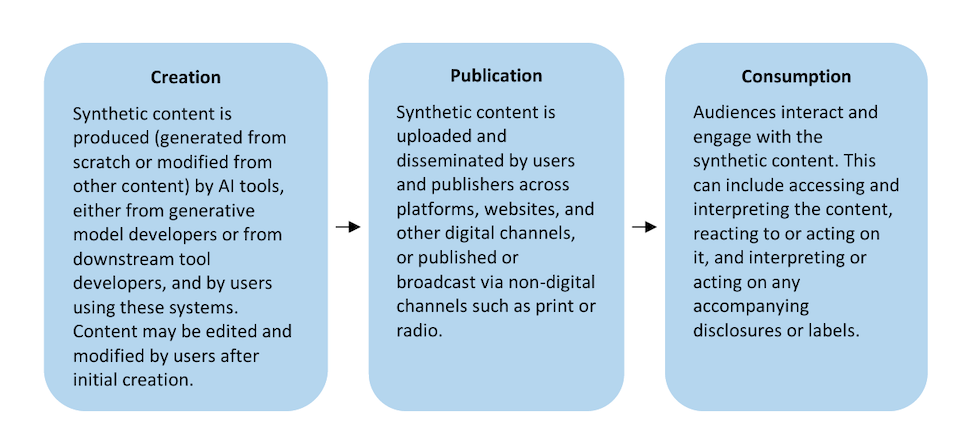 Source: NIST AI 100-4, Fig. 1, 2024. Adapted with attribution.
What happened in this small set of cases
Most of the incidents in this sample cluster around two episodes.
First, multiple reports on May 12 described President Donald Trump sharing an AI-generated image on Truth Social depicting Barack Obama, Joe Biden, and Nancy Pelosi in a sewage-filled Lincoln Memorial Reflecting Pool, alongside the caption “Dumacrats Love Sewage.” Across the reporting provided here, the image was presented as an AI-produced political insult tied to Trump’s commentary on the pool’s renovation and related cost criticism.
Second, several reports from May 8 described actor Mark Hamill posting an AI-generated image on Bluesky depicting Donald Trump in a shallow grave with the words “If Only.” According to the reporting, the White House condemned the post, Hamill later apologized, and he said he was not wishing for Trump’s death but for accountability.
A third incident, dated May 10, involved Trump sharing an AI-generated composite image of sunken Iranian warships while the administration was reportedly awaiting a response to a proposed peace plan. Unlike the other cases, the reporting says the post identified the image as AI-generated and described it as a composite.
That distinction matters. In this sample, not every synthetic image appears to have been presented in exactly the same way. Some were reportedly framed as overt political expression or provocation. At least one was reportedly labeled as AI-generated. But labeling alone does not remove the broader trust issue, especially when an image is still used to shape perception, dramatize a claim, or reinforce a narrative.
The pattern is less about novelty than about use
This small set of incidents does not support a sweeping claim about all deepfake activity. It does, however, support a narrower observation.
In the cases we’ve looked at here at Realz, synthetic images were used in highly charged political contexts where the intended effect appears to have been reputational, rhetorical, or persuasive rather than operationally complex. These were not subtle forgeries designed to pass a forensic inspection. They were reported as emotionally loaded visual messages.
That is worth paying attention to because public trust can still be damaged by crude or obvious synthetic imagery. A fake image does not need to be technically perfect to spread, polarize, or frame a debate. It only needs to be timely, legible, and aligned with an audience’s priors.
This is one reason the deepfake conversation can become too narrow when it focuses only on technical sophistication. In practice, the more relevant question is often simpler: what was the image trying to make people think, feel, or do?
Across these incidents, the apparent aims varied slightly:
- to humiliate political opponents
- to intensify partisan messaging
- to visualize violence or degradation symbolically
- to attach a synthetic image to a broader political claim
That does not make every case equivalent. The Hamill case was followed by an apology and clarification. The Iranian warships case was reportedly labeled as AI-generated. The sewage image cases were framed in reporting as slanderous or defamatory political attacks. But across all of them, the common thread is that synthetic visuals were part of public persuasion, not just private experimentation.
Why this matters for digital trust
The supplied background material supports a broader but still careful point: manipulated or synthetic visuals are best understood as trust and decision-quality problems, not only content problems.
That framing fits these incidents. When public figures or highly visible accounts circulate synthetic images, the damage is not limited to a single post. The wider effect is to increase uncertainty around what images mean, what they document, and what standards audiences should expect from influential communicators.
This is especially relevant when the subjects are real people and the context is political conflict. Even if viewers suspect an image is fake, the image can still do reputational work. It can still normalize contempt. It can still collapse the distance between satire, harassment, propaganda, and misinformation.
And once that visual norm shifts, the verification burden rises for everyone else: journalists, researchers, communications teams, public officials, and ordinary users trying to decide what they are looking at.
Labeling helps, but it is not the whole answer
One of the incidents in this sample reportedly involved a post that identified the image as AI-generated. That is better than passing synthetic media off as documentary reality. But it would be too generous to say that disclosure solves the problem.
The academic and institutional material supplied for this draft supports a restrained version of that point. NIST’s work on digital content transparency makes clear that provenance, labeling, and related transparency measures can improve traceability and trust signals, but they do not automatically verify the truth of the broader claim around an image.
That is a useful distinction here.
An image can be disclosed as synthetic and still be used to inflame, ridicule, or mislead by implication. Disclosure matters. Context still matters too.
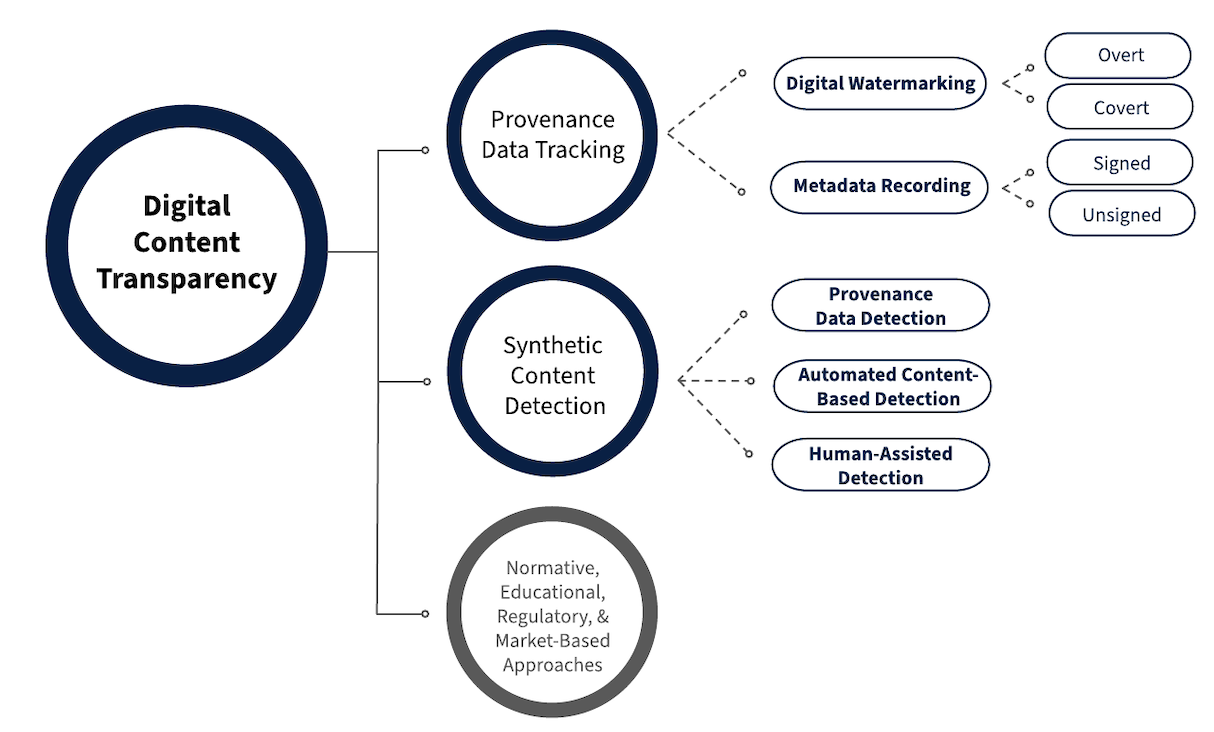 Source: NIST AI 100-4, Fig. 2, 2024. Adapted with attribution.
A narrow lesson from this incident set
Because this sample is small, recent, and concentrated in U.S. political discourse, the available material supports a narrower conclusion rather than a sweeping one.
The incidents reviewed here suggest that AI-generated images are becoming part of the everyday visual language of political conflict, at least in some corners of public discourse. In this set, the images were not primarily about realism for realism’s sake. They were about symbolic force: sewage, graves, sunken ships. They compressed complex political hostility into instantly shareable visuals.
That matters because synthetic imagery lowers the cost of producing scenes that would once have required design work, editing skill, or a much slower propaganda pipeline. It makes image-based provocation easier to produce and easier to circulate.
Beyond that, the evidence in this draft is limited. We cannot say from these incidents alone how widespread this pattern is, whether it is accelerating, or how audiences interpreted each image.
What organizations and institutions should take from cases like these
The background reference material is strongest on one practical point: visual-authenticity incidents should be treated as verification and governance issues, not just moderation or aesthetics issues.
Even though the incidents here are political and public-facing, the lesson travels more broadly.
If your organization relies on images in communications, brand channels, executive messaging, media relations, or evidence review, a few basic questions matter:
- Do you have a clear standard for when synthetic or materially altered visuals can be published?
- Is there an approval path for high-risk visual content involving real people, public claims, or sensitive events?
- Can teams distinguish between disclosure, provenance, and actual verification of the claim being made?
- Do communications, legal, security, and leadership teams know who owns escalation when a harmful synthetic image appears?
These are basic governance questions, but they are increasingly important. As NIST’s transparency framework suggests, no single control is enough. Detection, labeling, provenance, policy, and human review each cover different parts of the problem.
The practical trust problem ahead
The most grounded takeaway from this small set of incidents is not that “nothing is real anymore.” The supplied material argues against that kind of fatalism, and so do we.
A better conclusion is that visual trust now requires more process.
When synthetic images are used by prominent figures, celebrities, or political actors, the public sphere absorbs the cost. Viewers have to do more interpretive work. Reporters have to verify more carefully. Institutions have to think harder about provenance, disclosure, and response.
In other words, the problem is not just fake pictures. It is the growing operational burden of deciding what deserves trust, what requires context, and what should never have been treated as evidence in the first place.
That is the real significance of the incidents we’ve looked at here at Realz. In this small editorial sample, synthetic imagery was not peripheral. It was part of the message itself.
And once that becomes normal, trust does not disappear overnight. It just gets more expensive to maintain.